





Red light. Most people's first thought: a red light district. That moody red glow behind a window.
Not exactly the first thing you associate with a good night's sleep.
And yet. If your bedroom looks a bit like a quiet corner of a red light district in the evening, you're doing something right.
Because red light might just be the most underrated tool for better sleep there is.
Why the color of light matters so much
Your body doesn't respond to light as one single thing. It responds to the wavelength of light. And that wavelength decides which signal goes to your brain.
Blue light, the wavelength that dominates sunlight and the light from your phone and laptop, sends a clear signal to your suprachiasmatic nucleus: it's daytime. Stop making melatonin. Stay awake and alert.
Red light works the other way around. Red light has a wavelength of roughly 620 to 700 nanometers, and it barely triggers your alertness response. Your brain reads it as: it's getting dark. The day is ending. Start winding down for the night.
That's no coincidence. It's evolution. The light of a setting sun, a campfire or candles is naturally red and orange. It was the only light our ancestors had in the evening. Their brains learned that red light means evening. Time to relax.
We haven't changed that system. But we have changed our light. And we pay the price for it every night.
What red light actually does
A study published in the Journal of Athletic Training looked at the effect of red light on sleep quality in female basketball players. The group that got red light every evening for two weeks slept significantly better, had higher melatonin levels and performed better during the day.
But it goes beyond melatonin.
Red and infrared light have a direct effect on your cells. They stimulate your mitochondria, the power plants of your cells, to make ATP more efficiently. ATP is the fuel your body uses for recovery, repair and growth. Exactly the processes that happen at night.
In other words: red light in the evening doesn't just get your body ready for sleep, it also kicks off the processes that make your sleep truly restorative.
How to put it into practice
You don't need an expensive red light therapy lamp to benefit from this. Those definitely work, but there are simpler steps.
Start by swapping the regular bulbs in your bedroom and living room for warm, orange or red-tinted light. Bulbs with a color temperature below 2700 Kelvin are already a good choice. Candles work great too. They naturally sit in the red part of the spectrum.
Dim your lights one to two hours before bed. It's not just the color that counts, it's the brightness too. Brighter light, even in a warm color, keeps your nervous system active longer than soft, dimmed light.
And the bedroom itself? As dark as possible once you go to sleep. Red light is for the evening, for winding down. While you sleep, you don't want any light at all.
The habit for this week
Tonight, swap one lamp in the room where you spend most of your evening for a warm, orange or red one. Or light a candle and switch off the big light.
Do this for a week and notice what changes in how quickly you get sleepy.
You don't have to turn your bedroom into a red-lit window, but leaning a little in that direction? That's just right.
1% better every night.
Guy Veeke
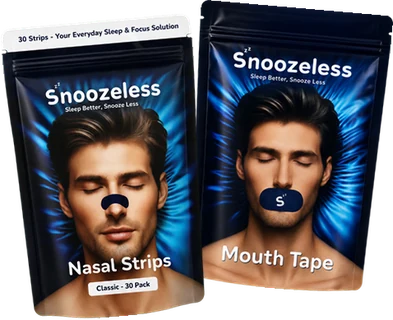
P.S. Red light puts your body into rest mode. But what happens next, while you sleep, also depends on how you breathe. Breathing through your mouth keeps your nervous system active without you noticing and lowers the quality of your deep sleep. Breathing through your nose does the opposite. Our Mouth Tape keeps your mouth closed, so you automatically breathe through your nose. Check it out here.


